Vol. I  ✦  London Sunday, 16th August 2026 Est. MMXXVI  ✦  Free to subscribers
📰 The Penny Dreadful Edition — the latest stories, printed for the tea table Download today’s paper (PDF) → Updated 16 Aug 2026
Today’s Edition
Opinion

Stop Passing Laws and Start Reading the Old Ones

Stop Passing Laws and Start Reading the Old Ones
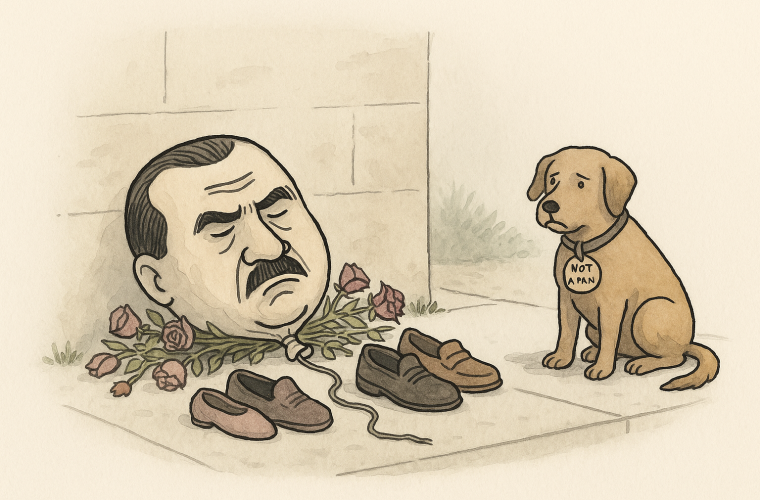
✦ Editorial cartoon — house style ✦

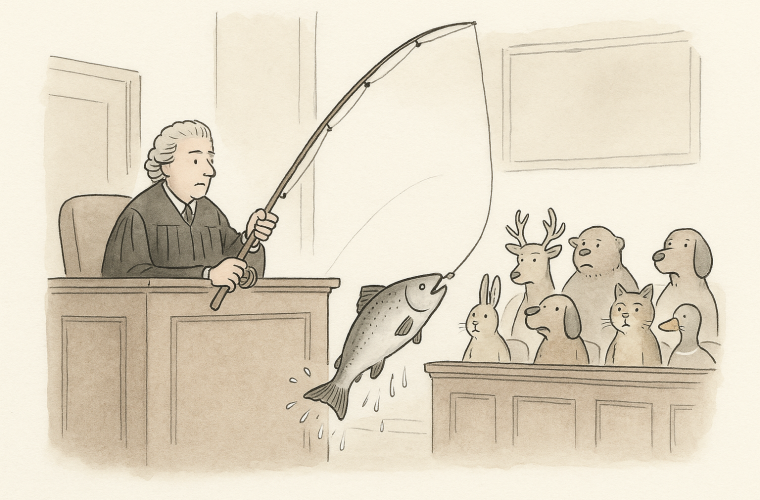
It is, at the time of writing, a criminal offence in England and Wales to handle a salmon in suspicious circumstances. Not to steal one, mind — theft was already covered, thank you very much, since roughly the Bronze Age. Section 32 of the Salmon Act 1986 exists because Parliament, faced with a poaching problem, decided the answer was a brand-new offence with a name that sounds like a rejected Monty Python sketch. Nearly forty years on, it’s still there. Nobody has ever mustered the energy to tidy it up.

And that, in one fishy anecdote, is the modern political disease. Ask a politician what they’ll do about anything — knife crime, potholes, the moral collapse of the young — and the answer is always the same: new legislation. A bill. A crackdown. Something with a stern name to wave at the cameras. Whether the last seventeen laws on the same subject were ever enforced, funded or even read is a question for the birds. Legislation has become the political equivalent of looking busy when the boss walks past.

The numbers are genuinely startling. New Labour, according to widely reported analysis at the time, created more than 3,000 new criminal offences between 1997 and 2010 — pushing towards one for every single day Tony Blair and Gordon Brown were in office. Not new laws, mind: new ways of being a criminal. One a day, like a vitamin.

The Cameron years were supposed to be the corrective. The coalition came in promising a bonfire of red tape — ‘one in, one out’ for regulation, later upgraded, with a straight face, to ‘one in, two out’. And yet by one count the Cameron administration still managed to produce over 4,000 new laws. That’s the thing about the sausage machine: even the people elected to switch it off end up feeding it. And that headline figure doesn’t even capture the real torrent, because most law in this country never troubles the House of Commons at all. It arrives as statutory instruments — ministerial regulations nodded through in their hundreds every year, scrutinised by approximately nobody, printed on legislation.gov.uk and read by even fewer.

Here’s the uncomfortable arithmetic: if a law worked, you wouldn’t need seventeen sequels. The fact that every Parliament produces a fresh Criminal Justice Act — there have been so many they need years bolted on to tell them apart, like Rocky films — is not evidence of vigour. It’s evidence that the last one didn’t do the job, and neither will this one, because the problem was never a shortage of statute. It was a shortage of coppers, courts, prison places and patience.

Continue reading →
❧ The Deeper Dive ❦
Nowhere to Salute: How Europe Learned to Evict Its Dead Dictators
Long-form · 7 min read

Nowhere to Salute: How Europe Learned to Evict Its Dead Dictators

From Hess's grave to Hitler's birthplace-turned-police-station, the long war against tyrant tourism — and the sad pilgrims who keep losing it.

Shortly before dawn on 20 July 2011, a small crew of workmen in the Bavarian town of Wunsiedel dug up Rudolf Hess. Hitler's deputy had been in the ground since 1987, when he hanged himself in Spandau prison at the age of 93, and the local Lutheran parish had finally had enough of

Settle in →
More from the Archive
The City That Throws Away Its Heating Reportage

The City That Throws Away Its Heating

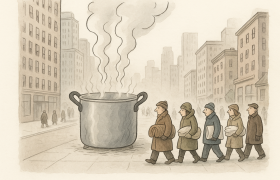
Two-thirds of the energy produced by a typical nuclear power station goes straight into the nearest large body of water. Not through incompetence, not through some scandalous cover-up, but through the plain arithmetic of thermodynamics: a reactor turns roughly a third of its heat

The Plagiarism Detector That Can Finally Read Science

The Plagiarism Detector That Can Finally Read

The world's most widely used plagiarism detector cannot detect plagiarism. It never could. What Turnitin and its rivals actually do is match strings of characters — a task closer to spotting duplicate barcodes than to reading — and for twenty-odd years universities have treated t

The Earth Is Flat and So Is My Faith in Humanity Opinion

The Earth Is Flat and So Is My Faith in Humanity

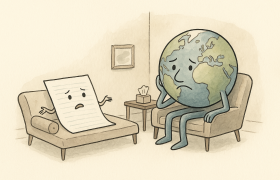
In 2018, a flat-earther spent twenty thousand dollars on a laser ring gyroscope to prove, once and for all, that the planet doesn't spin. The device promptly registered a drift of fifteen degrees per hour — which, for anyone keeping score, is precisely what you'd expect to see on

Science Talks on the Afterlife Reportage

Science Talks on the Afterlife

Death, these days, has a marketing department. There are bestselling memoirs of heaven, streaming documentaries about surviving it, TED talks with soft lighting, and a steady drip of neuroscience press releases about the dying brain lighting up like the Blackpool illuminations. E

Manchesterism Economics

Manchesterism

There is a particular kind of silence that descends on a room when a politician says the word "productive" with a capital P. You can almost hear the spreadsheets sweating. Somewhere in the Square Mile a man in a quarter-zip puts down his flat white and frowns, because he has read

The Digital Afterlife. Reportage

The Digital Afterlife.

In January 2021, the United States Patent and Trademark Office granted Microsoft a patent for building a chatbot out of a specific person's texts, emails and voice messages — including, the filing made clear, a person who happens to be dead. Microsoft's own general manager of AI